Why Manuscript Rejection Is Built into Academic Publishing
Created: 3/11/2026, 1:38:25 PM · Updated: 3/11/2026, 2:02:58 PM
Manuscript rejection is one of the most discouraging experiences in an academic’s life. It is easy to interpret a rejection as a judgment on a researcher’s research ability, language skills, or even their place in the academic community. In reality, rejection is not an exception in academic publishing. Journals are designed to reject most submissions, not because they are poorly written. Instead, rejection functions as a built-in filter in a highly competitive system. Understanding this reality can help you see rejection not as a failure, but as part of the process of improving and positioning your work.
Rejection in academic publishing is common. Almost all of us remember receiving the email that begins with ‘We regret to inform you…’
Despite how routine this message is, it rarely feels routine when it arrives. For students and early-career researchers, rejection can feel deeply personal, like evidence that ‘I am not good enough.’ For English-as-a-second-language (ESL) authors, rejection letters can feel especially harsh because the tone and nuance of English are often difficult to interpret.
With time, most of us become habituated to rejection. Experience teaches us that a paper will usually find a home; if not in this journal, then in another. Importantly, senior researchers and principal investigators learn not to equate rejection with self-worth. It is worth asking: how common is rejection, really?
Rejection is the norm, not the exception
Data make this clear. In a 2020 anonymous survey of clinical faculty at the University of Minnesota, nearly 96% of respondents reported manuscript rejections. Almost half (44%) had papers that required four or more submissions before acceptance.
Similarly, APA journals, which routinely share their publication statistics, reported rejection rates near 70% in 2023. Cancer Science (published by Wiley) had an acceptance rate of approximately 11% in 2024. High-profile journals are even more selective: Nature accepts roughly 8% of submissions. In 2024, Science and Science Advances reported acceptance rates of 5.8% and 8.2%, respectively.
Seen this way, rejection is not an anomaly but a structural feature of academic publishing. It is built into the publication system.
Not all rejections are the same
Before reacting to a rejection letter, ask yourself: Was this a decision about scope, priority, or execution? Broadly, manuscript rejections fall into three major categories:
- Desk rejection: Editors decide a manuscript is not a fit for the journal’s scope or audience before peer review occurs.
- Post-review rejection: Reviewers assess your manuscript but recommend against publication in that specific journal.
- Post-revision rejection: A manuscript is declined after authors attempt to respond to reviewer comments.
Understanding which kind of rejection you received is the first step toward responding productively.
Rejection does not necessarily predict impact
While the exact circumstances of some historical rejections are debated, rejection does not always predict future impact. Take the case of PCR. Manuscripts involving this technique were initially rejected by both Science and Nature. However, the technique ultimately revolutionized molecular biology. Similarly, Lynn Margulis’s work on endosymbiosis was rejected by over a dozen journals. Her work eventually reshaped our understanding of cell evolution. Finally, take the case of Shimon Sakaguchi, the 2025 Nobel Laureate in Physiology and Medicine. His landmark 1995 paper on regulatory T cells was published in The Journal of Immunology after the work was reportedly rejected by Nature.
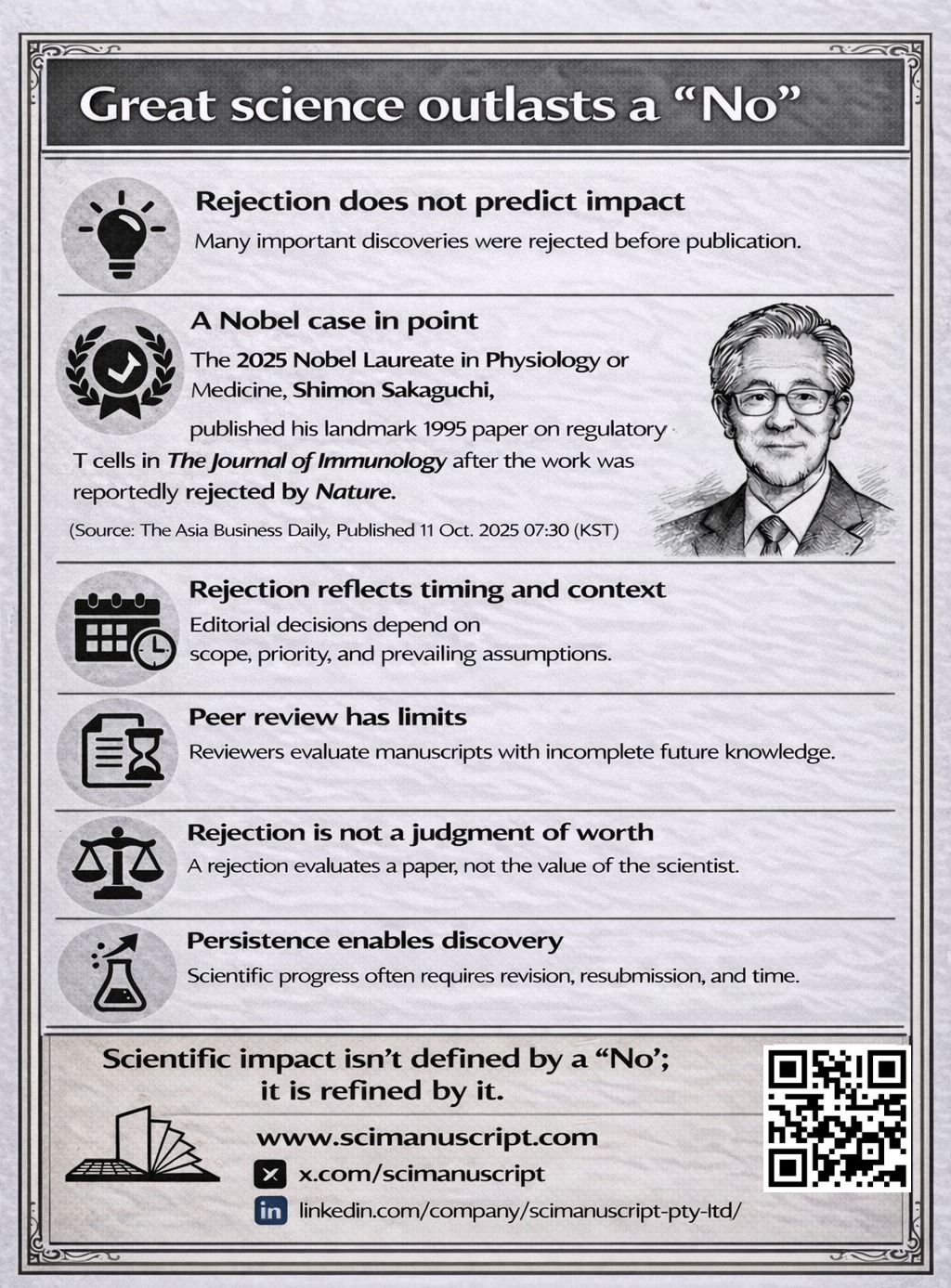
We are not trying to suggest that the peer-review system is broken. Instead, these historical examples demonstrate that rejection often reflects current trends rather than the future value of your work. Most importantly, a rejection letter is not feedback on your worth as a scientist; it is feedback on a manuscript’s fit at a particular moment.
How can we use rejection productively?
From our experience, we can say that while it is difficult to suppress the emotional reaction to a rejection letter, it is important to separate that reaction from the analytical revision the manuscript requires. If you have faced multiple rejections, it is time to look for patterns across reviewer comments. For example, if multiple reviewers mention an unclear rationale or weak framing, that is a signal to rewrite the introduction rather than simply revise sentences. Prioritize clarity of argument over sentence-level perfection; language can be refined later. Show editors and reviewers that you have carefully addressed their concerns.
Responding to rejection is a learned academic skill, developed only through repeated experience. Rejection teaches authors how to revise more effectively and how to reduce the likelihood of future rejection (experience matters).
Summary
Manuscript rejection, while emotionally difficult, is statistically normal and historically unremarkable. It is not the end of a paper’s life; more often, it is simply part of its development.
Rejection is supposed to be professional, but it rarely feels that way. It seeps into your confidence and begins to feel personal. Guard that perspective carefully.
Step away when you need to. Watch the sunset. Take a walk in the park and/or call your loved ones and friends. They will remind you who you are beyond your manuscript. Share your frustration. In time, things will settle. Believe us, they usually do.
In the next few posts, we will focus on the specific reasons behind desk rejection and peer-review rejection, and how you can avoid them. For now, remember this idea that one of us had come across on social media: Rejection is not a signal to stop; it is a signal to recalibrate.
About the Authors: This article was written collaboratively by Anupratap Tomar, PhD (Head of the Neuroscience Editing Team at SciManuscript, Australia), and Sraboni Chaudhary, PhD (University of Michigan, USA). The perspectives shared here reflect their experience as researchers and reviewers, along with Dr. Chaudhary’s experience as a journal handling editor.
Connect with SciManuscript:
X: https://x.com/scimanuscript
LinkedIn: https://www.linkedin.com/company/scimanuscript-pty-ltd